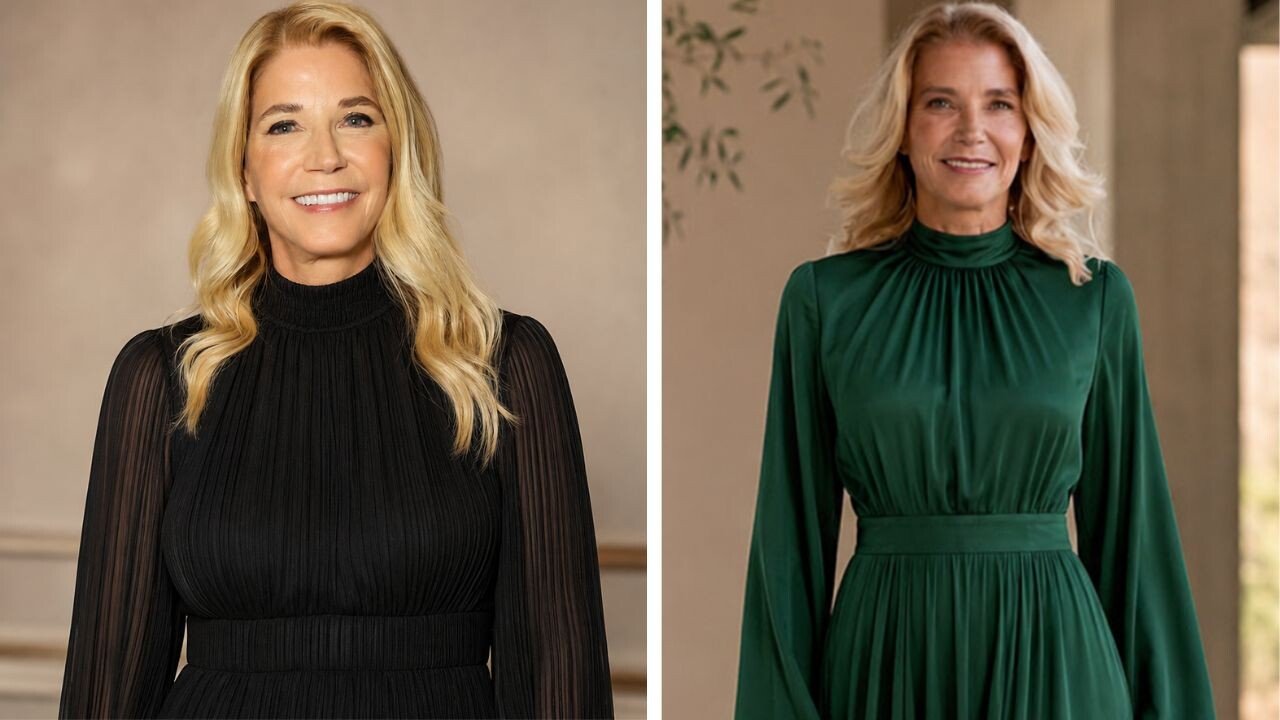
Candace Bushnell built her writing career by observing New York society and examining how money, ambition, independence, and gender expectations affect people’s choices. After arriving in the city at 19, she moved from modest freelance assignments to a prominent newspaper column and then to a body of published books.
Her original writing later reached a broader audience through adaptation, but her role as the author of the source material remains distinct from the work of the creators who developed it for television. She has since expanded her professional work through essays, public appearances, and autobiographical stage performances.
| Field | Details |
|---|---|
| Full name | Candace Bushnell |
| Born | December 1, 1958 |
| Birthplace | Glastonbury, Connecticut |
| Profession | Author and columnist |
| Parents | Calvin Lawrence Bushnell and Camille Salonia Bushnell |
| Siblings | Two younger sisters, Alyssa and Deirdre |
| Education | Attended Rice University and NYU’s Gallatin School |
| Published bibliography | 10 books listed on her official website |
| Recognition | 2006 Matrix Award from New York Women in Communications |
Connecticut Roots and the Move to New York
Established professional profiles and reputable reporting place Candace Bushnell’s birth in Glastonbury, Connecticut, on December 1, 1958; her official biography does not publish the date. Her parents were Calvin Lawrence Bushnell and Camille Salonia Bushnell. She grew up with two younger sisters: Alyssa, who is one year younger, and Deirdre, who is four years younger.
Bushnell spent approximately one year at Rice University before continuing her studies at New York University’s Gallatin School. Institutional records and published interviews confirm her attendance at both universities, although the available documentation does not establish that she earned a degree from either institution.
At 19, she moved to New York City to pursue writing. Her earliest assignments did not provide immediate financial security. She has recalled receiving $50 for one early piece and $1,000 for an unpublished children’s-book assignment. Those modest payments formed part of a long period in which she continued working despite rejection and uncertain earnings.
New York later became the setting and principal source material for the newspaper column that established her career.
The Newspaper Column That Established Her Voice
Bushnell began writing her best-known column for the New York Observer in 1994. Rather than approaching city life as a conventional advice writer, she examined social behavior, status, money, ambition, and the expectations placed on women.
She has described herself as an observer and a “social anthropologist.” The phrase represents her own description of how she studies people and social patterns, rather than a formal academic qualification. Her method relied on noticing how people spoke, behaved, and presented themselves within particular social circles.
Carrie Bradshaw initially functioned as an alter ego through whom Bushnell could reshape personal material. She has explained that the fictional name also gave her some distance from the more explicit elements of her writing and made it less likely that her parents would immediately identify every experience as her own.
Bushnell has emphasized that Carrie began with elements of her life but developed into a character whose experiences diverged from her own.
The newspaper columns were collected and published as a book in 1996. Some later profiles have used 1997, apparently because of subsequent editions, but publishing records place the original release in 1996. That transition from serialized newspaper writing to a published book established the foundation for her broader career as an author.
Building a Wider Career as an Author
Bushnell’s official bibliography lists 10 books. Her work expanded beyond the original newspaper material while continuing to address professional ambition, financial independence, social expectations, and the choices available to women.
Her breakthrough also created opportunities beyond newspaper publishing. HBO paid approximately $100,000 to option the source material. Bushnell created the original column, book, and characters, while Darren Star created the television adaptation.
Bushnell has said that she later received a million-dollar publishing contract. That figure describes a particular contract during her career; it is not a reliable measure of her current finances or overall wealth.
Her professional recognition includes the 2006 Matrix Award from New York Women in Communications. The organization’s institutional record lists her among its honorees, recognizing her work in the communications field.
The progression from newspaper assignments to a substantial publishing contract did not happen immediately. Her account of the period emphasizes continued work through low pay and rejection before the column gave her a recognizable public platform.
Her Writing Process and Professional Habits
Observation remains central to Bushnell’s professional method. She has approached writing as a way to examine behavior rather than simply record events. Characters may begin with recognizable experiences or social types, but the finished work involves selection, reconstruction, and invention.
In a 2019 interview, she described a routine that included reading at night and limiting unnecessary online scrolling. That account represents her habits at the time rather than a permanent daily schedule, but it offers a direct view of how she protected time for reading and creative work.
She has also spoken candidly about the amount of unused material involved in writing a book. During a 2020 podcast interview, Bushnell said that producing 50 to 100 pages that do not survive into the final manuscript can be a normal part of developing a book.
Independence, Feminism, and Women’s Choices
Bushnell has directly characterized her work as feminist. Her central concerns include women’s ability to support themselves, pursue professional ambition, and make personal decisions without being defined entirely by conventional expectations.
Financial independence is especially important in her public comments. Her own early years in New York involved limited income, while later professional success brought substantially larger publishing opportunities. She has continued to emphasize that women need the ability to maintain an independent identity and support themselves.
Her personal experiences also informed this outlook. Bushnell married ballet dancer Charles Askegard in 2002 and filed for divorce in December 2011. She later said that divorce reinforced the importance of maintaining an independent identity and the ability to support herself. The exact date of the final dissolution is not established in the reviewed records, although the marriage is generally described as ending around 2012.
Bushnell does not have children and has spoken publicly about living child-free. Her comments have addressed the way society evaluates women who do not become mothers and the importance of respecting different circumstances and choices. She has not presented the subject as a simple question of either regret or celebration.
These views appear in her writing as part of a wider interest in how women navigate work, money, identity, age, and social pressure.
Burnout, Grief, and Creative Reinvention
Professional success did not remove periods of creative and emotional difficulty. Bushnell has spoken directly about burnout, solitude, and the effort required to recover her creative voice after major changes in her life.
While developing one of her later books, she experienced depression and grief. In interviews, she connected that period with her father’s death and the suicide of a friend.
She also described the challenge of rebuilding after age 50. That process involved reconsidering both her personal identity and the kind of work she wanted to create. Instead of presenting later life as a settled stage, she wrote about the practical and emotional work involved in beginning again.
Her later interviews and writing addressed aging, independence, loss, and finding a new direction after major life changes.
New Ways of Reaching Readers and Audiences
Bushnell has extended her work beyond newspaper columns and books through live autobiographical performances. These appearances draw on her career and personal experiences while allowing her to communicate directly with an audience.
She has said that live performance offers something publishing cannot provide immediately: a visible response from the people hearing the material. With a book, reader reactions often arrive much later. On stage, she can recognize in real time which observations or stories connect with an audience.
Her public work has continued in recent years. In June 2025, she published a first-person essay addressing life, aging, and personal change after 60. She also continued performing in 2026, including an appearance at George Street Playhouse on February 19, 2026.
As of August 15, 2026, her official events page and the University of Illinois Springfield Performing Arts Center listed a performance scheduled for November 7, 2026. Her official professional contact information also identified Independent Artist Group as her representative.
These projects allow her to revisit subjects developed during her years as a columnist while presenting them through essays, conversations, and live storytelling.
A Writing Career That Continues Beyond the Original Column
Bushnell’s career remains grounded in social observation and sustained writing. After establishing herself through newspaper work, she expanded into books, essays, public appearances, and live storytelling while continuing to examine women’s independence, ambition, aging, and social expectations.
For more info, visit Journal Magazine.