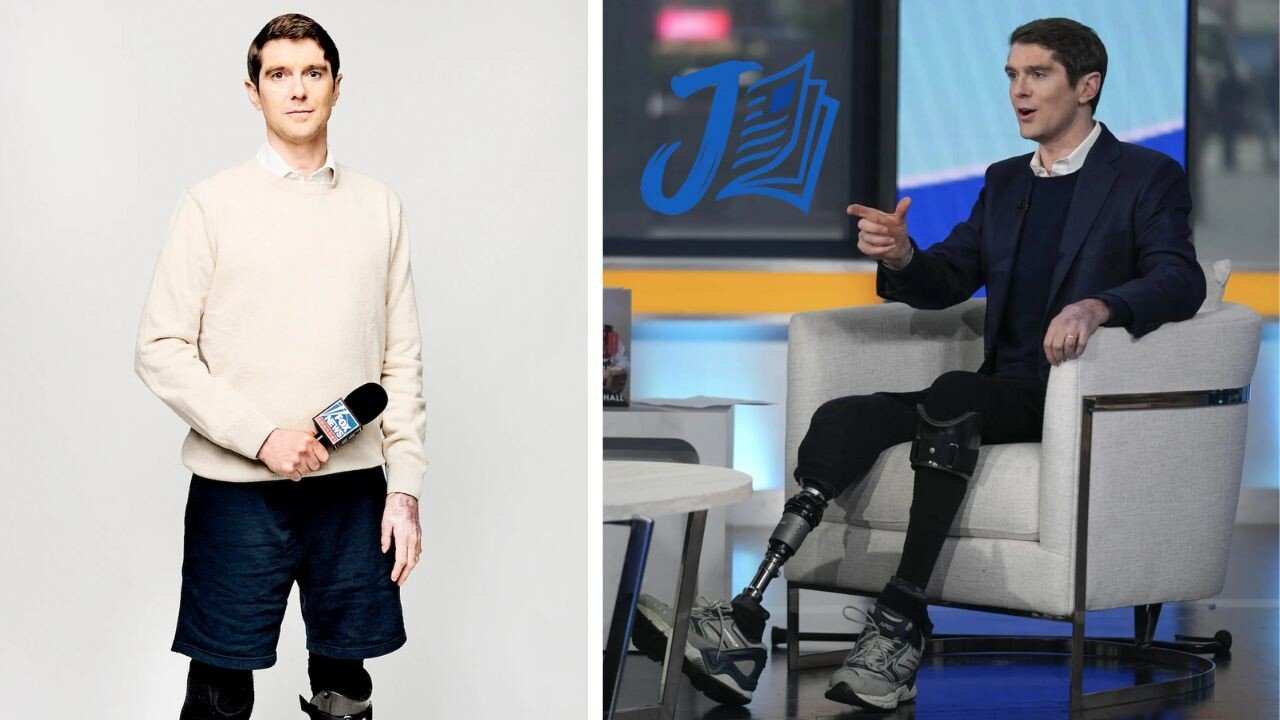
Benjamin Hall is a British-American journalist whose career changed permanently after he was critically injured while covering the war in Ukraine. The attack near Kyiv in March 2022 killed two of his colleagues and left him facing amputations, impaired vision, hand damage, and an extended medical recovery.
He returned to live broadcasting in January 2023, followed by a return to the U.S. State Department briefing room. He has since continued working as a Fox News senior correspondent while writing about recovery, presenting a podcast, and supporting public-service projects.
| Field | Details |
|---|---|
| Full name | Benjamin Hall |
| Profession | Journalist and Fox News senior correspondent |
| Citizenship | United States and United Kingdom |
| Education | Duke University, Richmond American University in London, and University of the Arts London |
| Residence | London |
| Spouse | Alicia Meller |
| Children | Four daughters |
| Current podcast | Searching for Heroes with Benjamin Hall |
Building an International Reporting Career
Before joining Fox News, Hall worked as a correspondent covering conflicts in the Middle East and Africa. Official biographies from Fox News and Hachette connect his earlier reporting with outlets including The New York Times, BBC, The Times of London, The Sunday Times, Agence France-Presse, ITN, Channel 4, and Esquire. His reporting regularly placed him near armed conflict.
That experience preceded the Ukraine assignment that permanently altered his health and career.
Hall joined Fox News in 2015. He later served as the network’s foreign correspondent and State Department correspondent before becoming a senior correspondent. His work included reporting from conflict areas and covering international affairs from Washington.
The Ukraine Attack That Changed His Life
On March 14, 2022, Hall was traveling near Horenka, outside Kyiv, with Fox News camera operator Pierre Zakrzewski and Ukrainian journalist Oleksandra Kuvshynova when their vehicle came under fire. Zakrzewski and Kuvshynova were killed, while Hall was critically injured.
Hall later confirmed the extent of his injuries. He lost a lower leg and the foot on his other side, lost sight in one eye, and sustained damage to a hand, his hearing, and his head. His condition required repeated surgery, prosthetics, and lengthy rehabilitation.
Early accounts described the vehicle as being struck by incoming fire, while Hall and later reputable reporting attributed the attack to Russian forces. Separate litigation has raised questions about the assignment and related safety decisions. A June 2026 federal appellate record showed that the proceedings were continuing without a final determination of liability.
Evacuation, Treatment, and the Goal of Returning Home
After receiving initial assistance in Ukraine, Hall was evacuated with help from the nonprofit organization Save Our Allies. He traveled through Poland before being taken by the U.S. military to Landstuhl Regional Medical Center in Germany. Treatment later continued at Brooke Army Medical Center in San Antonio, Texas.
CBS News reported in February 2025 that he had undergone approximately 40 surgeries and hundreds of hours of physical therapy. Earlier accounts referred to more than 30 operations, reflecting the continuing nature of his treatment rather than a settled final total.
Rehabilitation required Hall to learn how to use prosthetics and rebuild his mobility. He told People that he divided the process into measurable walking goals, gradually increasing the distance he hoped to cover. These smaller targets helped make an extensive recovery more manageable.
Returning home remained his primary objective. Hall and his wife, Alicia Meller, decided that he would continue treatment in Texas while she remained in London with their daughters. The arrangement allowed the children to stay stable while he focused on rehabilitation.
Hall has repeatedly credited Alicia with managing the family during his absence and supporting his recovery. The couple have four daughters: Honor, Iris, Hero, and Sage. Hall said that returning to his family was his primary motivation during rehabilitation.
Returning to Television and the State Department
Benjamin Hall returned to live television on January 26, 2023, less than a year after the attack. He discussed his injuries and recovery in his first live broadcast appearance, speaking directly about the colleagues who were killed and the work required to regain his mobility.
On May 1, 2023, he returned to the U.S. State Department briefing room. The appearance connected his physical recovery with a professional setting he had regularly covered before the attack.
Hall later returned to Ukraine in November 2023. During that visit, he interviewed President Volodymyr Zelenskyy and received Ukraine’s Order of Merit, Third Class. The Ukrainian government officially documented the honor.
His return did not erase the effects of his injuries. Prosthetics, impaired sight, hearing damage, and continued treatment remained part of his daily and professional circumstances. His work therefore resumed through adaptation rather than a return to his previous physical condition.
How Recovery Changed His Priorities
Hall has said directly that family now comes before work. Before the attack, his career regularly took him into conflict zones. Recovery changed that order, with his wife and daughters becoming his first consideration in decisions.
He has also rejected the idea that recovery means recreating his old life exactly. In interviews, he has described the process as building a different life around changed physical circumstances. That approach has shaped how he discusses rehabilitation, prosthetics, and professional independence.
Hall has encouraged direct but respectful conversations about disability. He has said that people should not be afraid to ask appropriate questions, because open discussion can reduce discomfort and help others understand what adapting to severe injuries involves.
Faith has also shaped his own explanation of recovery. He has spoken about it as a source of connection, hope, and resilience rather than presenting his experience as a medical recovery alone.
Despite what happened in Ukraine, he continues to defend the importance of conflict reporting. In his public comments, he has maintained that journalists must document wars and their effects, even while acknowledging the severe risks involved.
Books, Podcasting, and Public Service
Hall’s published work began before the attack on Ukraine. His 2015 book examined the rise of ISIS and drew on his experience reporting from conflict areas.
He later wrote Saved, released on March 14, 2023, describing the attack, evacuation, medical treatment, and determination to return to his family. His second recovery-related book, Resolute, was published on March 18, 2025 and focused on the principles and habits he used while rebuilding his life.
In March 2026, Hall expanded his published work with a children’s book, Read All About It!. He explained that a toy hedgehog his daughters gave him during treatment helped inspire the project.
He also presents Searching for Heroes with Benjamin Hall, a podcast featuring people who have confronted serious challenges or served others.
The Association of Foreign Press Correspondents recognized Hall in 2022.
Benjamin Hall’s Work and Priorities Today
Hall continues to work as a senior correspondent for Fox News. His professional activities now include reporting, interviews, public appearances, books, and podcasting, while his family remains based in London.
On June 7, 2026, he completed the Tunnel to Towers Tower Climb, covering 104 stories in a reported 46 minutes. His individual fundraising page recorded approximately $30,150 for the organization, which supports military members, first responders, and their families.
The climb added a measurable public milestone to the recovery he had previously described through shorter walking goals and physical therapy. It also connected his rehabilitation with an organization serving people affected by injury and loss.
Hall’s return to reporting occurred alongside permanent physical changes rather than after a complete restoration of his previous health. In his own accounts, family, faith, and adaptation became central to the way he approached recovery and continued work.
You can also read: Erika Jayne Shares Family Background and Personal Growth.
1 Comment